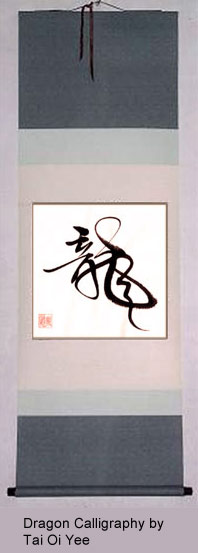
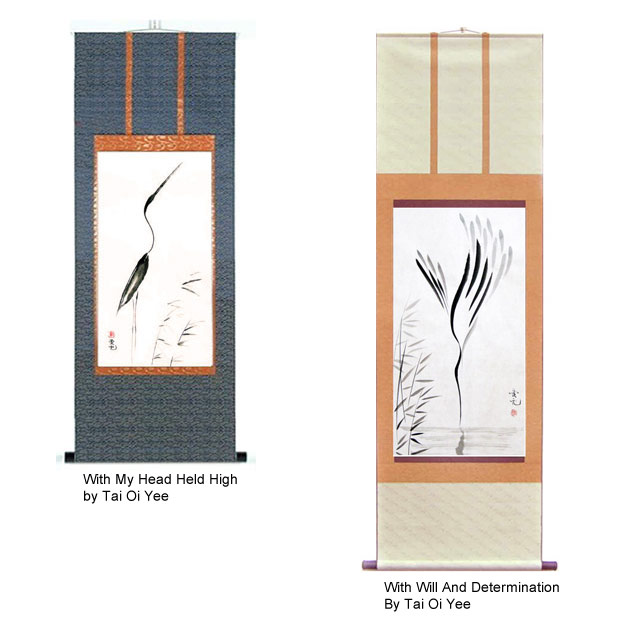
SCROLL MOUNTING :
Paintings on rice paper can be mounted onto silk scrolls using either the wet mount method or dry mount method.
Wet mounting is all done by hand the traditional way. It dates back to the Han dynasty (Around 200 B.C.). It is a dying art which requires superb skills, years of experience.
Dry mounting is the shortcut and cheap way which uses silicon adhesive.
Differences between wet and dry mounting:
Traditional wet mounting method is all done by hand and uses flour paste as the glue. It embodies the spirit of Chinese art, and requires superb workmanship. On the other hand, dry mounting uses silicon paper as the adhesive and uses either a mounting machine or a hot iron during the process.
Wet mounted paintings can be remounted in the future, but not so with dry mounted artwork.
Very often folds and creases appear in dry mounted scrolls due to carelessness or machine malfunction, and these errors cannot be corrected and the paintings are thus ruined.
Wet mount is also more environmentally friend than dry mount.
All famous masters' works and expensive paintings are wet mounted.
Different styles:
The most common forms are vertical wall scroll and horizontal wall scroll. Vertical scrolls are more convenient for hanging, but the horizontal scrolls are more suitable for sumi-e with a western feel.
There are different hanging scroll styles:
- 一色裱, one color mount
- 二色裱, two color mount
- 三色裱, three color mount
- 宣和裱 or 宋式裱,, Xuanhe style/ Song style
- 中堂裱, large hall painting style